How Much Money Does a Laser Tag Center Lose When One Session Gets Canceled?
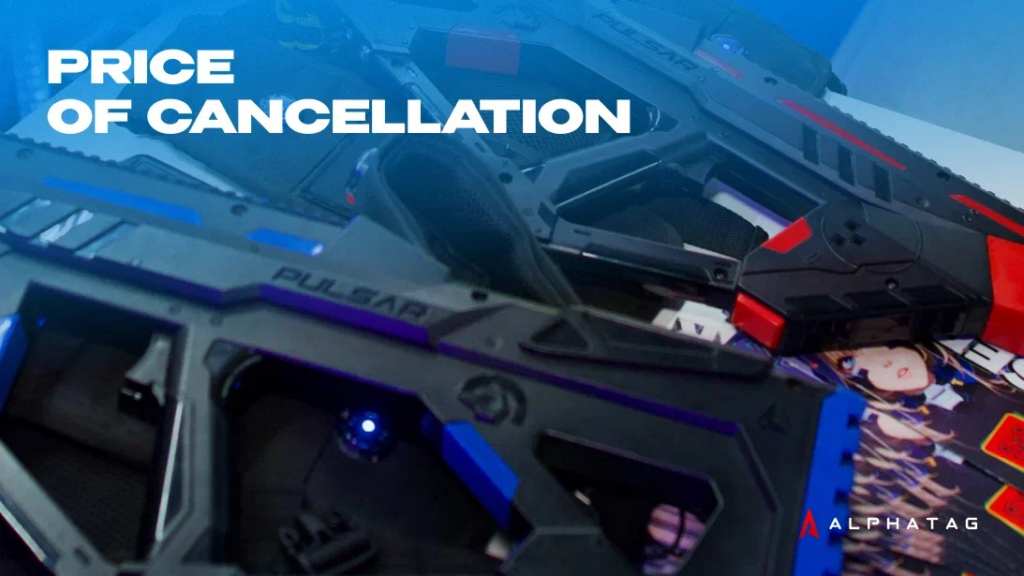
One malfunctioning set of laser tag gear may look like a small technical issue – until it forces you to delay, reschedule, or cancel a game.
Guests have already arrived. The game master has prepared the arena. The front desk has taken payment. There are only a few minutes left before the session starts, but one phaser will not turn on or works unpredictably. If there is no replacement ready, the center has three bad options: reduce the team size, delay the game, or cancel the session.
In every case, the business loses more than the price of one admission ticket.
Let’s break down where those losses come from and why reliable equipment, together with a smart reserve stock, directly affects a laser tag center’s profit.
Direct loss: the value of the canceled game
Suppose 10 players booked a game. In many U.S. markets, a standard laser tag session or player package may cost around $25 per person.
Planned game revenue:
10 players x $25 = $250.
If the game cannot be run and the payment has to be refunded, the direct loss is $250.
But that is only the first part of the calculation.
The center has already spent money and time:
- paid the front desk employee and game master;
- prepared and checked the arena;
- spent marketing budget to bring in the guests;
- used utilities and other operating resources;
- reserved a time slot that can no longer be sold to another group.
That means a canceled session is not just missed revenue. It is missed revenue after the business has already incurred costs.
One session can cost much more than $250
Now assume the guests did not book only a standard game. They also planned a party package:
- private party room rental;
- birthday decorations;
- party host or event coordinator;
- food and drinks;
- extra game rounds;
- use of interactive props or special game devices.
In that case, the real order value can easily reach $400-$700 or more, depending on the city, venue format, and package.
A weekend cancellation is especially painful. Prime time slots are limited, and an empty Saturday afternoon slot cannot be sold retroactively.
If a center runs four major sessions or group bookings in a day and one of them gets canceled, it may lose roughly a quarter of that day’s game revenue.
Hidden losses: what does not show up immediately in the register
The most serious consequences may appear later.
Lost repeat visits
For many guests, the first game is their introduction to the venue. If they experience a delay or cancellation instead of a smooth, exciting event, the chance of a repeat visit drops.
Suppose that four people from a 10-player group would have returned for another game. At $25 per player, the potential repeat-revenue loss is another $100.
And if one of those guests was considering booking a birthday party, team-building event, school outing, or corporate event, the missed revenue could be much higher.
Negative reviews
An unhappy customer may tell friends, post in a local parent group, or leave a public review on Google, Yelp, or social media.
Reputation damage is difficult to convert into an exact dollar amount. Still, even one negative review can influence several future customers, especially when they are choosing a venue for a child’s birthday party, youth group event, or company outing.
Compensation
To keep the relationship with guests, the center may need to offer:
- a free return game;
- a discount;
- extra game time;
- a gift card;
- a refund;
- a free add-on service.
This is the right way to handle customer dissatisfaction, but it also increases the cost of the technical failure.
Schedule disruption
If the manager or game master tries to fix the set in front of the guests, the start time is delayed. Then the next session starts late, and the one after that may be affected too.
One equipment failure can disrupt not just one group, but several groups in a row.
Calculating the full cost of a cancellation
For a practical estimate, use this formula:
Loss = canceled order value + costs already incurred + compensation + potential repeat revenue.
Here is a simplified example for a laser tag center:
- game revenue – $250;
- arena preparation and staff time – $60;
- gift card or comp offer – $75;
- potential repeat visit from part of the group – $100.
Total:
$250 + $60 + $75 + $100 = $485.
And that does not include reputation damage or delays to later games.
In other words, one failed equipment set can cost the center much more than it seems at first glance.
What to do if a set fails five minutes before the game
In this situation, the staff’s job is not to repair equipment on the spot. The job is to save the session.
A working procedure should look like this:
- Remove the malfunctioning set from the active equipment pool.
- Give the player a fully ready backup set.
- Check its connection and game settings.
- Start the session on schedule.
- Log the failure.
- After the game, run diagnostics internally or contact technical support.
If the backup laser tag set is charged and configured, replacement takes only a couple of minutes. Guests may not even notice that a technical issue occurred before the game.
Why buying exactly one set per player is not enough
If a center plans to host groups of up to 10 players and buys exactly 10 sets, any malfunction immediately reduces capacity.
One set is temporarily out of service – now only nine players can participate. If a 10-person group arrives, the center can no longer deliver the order in full.
For commercial operation, a 10+2 model is more practical:
- 10 sets are used in the game;
- 2 sets stay fully ready for fast replacement.
Why two backup sets?
The first backup covers a single equipment failure. The second protects the center if another issue appears, a battery is unexpectedly low, or an additional participant is added.
At the same time, backup equipment cannot simply sit in storage. It must be:
- charged;
- working;
- updated;
- configured for current game scenarios;
- available to the game master without lengthy preparation.
Reserve gear is not idle equipment
An owner may think: if two sets are not used in every game, they are not making money.
In practice, reserve gear performs a different economic function. It protects the revenue generated by the main equipment.
If backup gear helps the center save one $250 booking, it has already protected that amount of revenue.
If this happens several times per year, spare sets protect thousands of dollars in bookings, preserve the schedule, and protect the venue’s reputation.
So the question should not be:
“How much does an extra set cost?”
The better question is:
“How much will we lose if we do not have it at the exact moment we need it?”
How to reduce the risk of a canceled session
Backup gear alone is not enough. A center needs an equipment operations system.
Check all sets before guests arrive
Before each shift, the game master should check:
- whether every device powers on;
- battery level;
- connection between the phaser, head sensors, and other components;
- hit sensors;
- sound and light indicators;
- connection to the software;
- current game settings.
Checking equipment right before the game leaves too little time to solve a problem.
Keep a failure log
For every issue, record:
- equipment number;
- date and time;
- description of the problem;
- conditions when it appeared;
- actions taken;
- diagnostic result.
This helps the center notice recurring problems and send equipment for maintenance before failures affect customers.
Separate working and faulty equipment
A set with a known issue must be labeled immediately. It should not accidentally return to the active game pool before diagnostics are complete.
Train the staff
The game master should know:
- how to check equipment;
- how to replace a set quickly;
- which problems can be fixed on site;
- when a device must be removed from use;
- where to get technical consultation.
Why business-grade equipment is worth buying from LASERWAR
For a commercial laser tag center, the look of a phaser and its price are not the only important factors. What happens after the purchase matters just as much: how easy the equipment is to maintain, update, expand, and support.
LASERWAR offers not just individual devices, but a complete solution for running a laser tag business.
A complete ecosystem
Equipment, additional game devices, software, and scenarios work as parts of one system. A center can start with a basic setup and expand the arena’s capabilities as the business grows.
Technical support
If an owner or game master has a question, it is important to get qualified help from the manufacturer instead of trying to solve the problem alone during a busy shift.
Support helps with settings, updates, diagnostics, and daily operation.
Updates and equipment development
A laser tag system should not stay frozen at the level it had on the purchase date. LASERWAR continues to develop software, release updates, and add new features and game opportunities.
Solutions for different venue formats
When choosing equipment, a business should consider the real operating conditions:
- indoor arena or mobile field;
- outdoor field or indoor facility;
- children’s parties or tactical events;
- small local center or large family entertainment center;
- planned number of players;
- expected operating intensity.
LASERWAR specialists help select a configuration for the specific business model, including the right number of backup sets.
Experience with laser tag operators
An owner buys not only equipment, but also the manufacturer’s accumulated experience. This is especially important when launching a first venue, where mistakes in equipment selection can affect operations from the first months.
A reliable session starts before guests arrive
Technical issues cannot be eliminated completely. Equipment is used actively, receives physical stress, and requires regular maintenance.
But a technical problem should not automatically become a customer problem.
If a center uses reliable equipment, keeps reserve sets ready, trains staff, and can contact the manufacturer for support, a single malfunction remains an internal operational issue. The manager replaces the set, and the game starts on schedule.
That is why laser tag equipment for business should not be chosen by price alone. The whole system must be evaluated:
- reliability;
- ease of operation;
- scalability;
- software;
- technical support;
- availability of spare parts;
- manufacturer experience.
LASERWAR helps build that system – from equipment selection and reserve configuration to setup, launch, and ongoing operation.
Want to calculate the right equipment package for your venue and understand how many backup sets you need? Contact LASERWAR specialists. We will recommend a solution based on your arena format, number of players, and expected workload.